
San Diego is one of the most coveted real estate markets in the country — and also one of the most unforgiving for house flippers who don’t do their homework. With countywide median single-family home prices hitting $1,000,000 in late 2025 and competition for well-priced inventory at a fever pitch, the days of casually buying any distressed property and walking away with easy profits are long gone.
But make no mistake: San Diego is still a profitable rehab-to-relist market in 2026 — if you know where to buy.
The key insight most flippers miss is that San Diego isn’t one market. It’s dozens of micro-markets, each with its own entry prices, buyer pool, ARV ceiling, rehab expectations, and days-on-market dynamics. A strategy that crushes it in Logan Heights can bankrupt you in Pacific Beach if you don’t account for the vastly different risk profiles.
At Remade Home Construction, we’ve completed flips and renovations across San Diego County — from Carmel Mountain and Vista to North Park and Chula Vista. This guide is our honest, data-driven breakdown of where the numbers actually work for investors in 2026, and why.
Disclaimer: All price ranges and market data reflect publicly available sources and market conditions as of early 2026. Always run your own comps before making investment decisions.
Why Neighborhood Selection Is Your #1 Profit Lever
Before we get into the matrix, let’s talk about why neighborhood selection matters more than almost anything else in a flip — including your renovation scope or your contractor relationship.
In real estate investing, there’s a ceiling on what buyers will pay in any given neighborhood, regardless of how beautiful your renovation is. Over-improving a property relative to the neighborhood comp ceiling is one of the fastest ways to destroy your profit margin — and it’s an especially dangerous trap in San Diego, where labor and materials costs are among the highest in the nation.
Conversely, a well-executed, appropriately scoped renovation in a neighborhood with strong buyer demand and rising comps can generate returns that look almost too good to be true. The difference isn’t luck. It’s neighborhood selection.
Here are the key variables we use when evaluating a San Diego neighborhood for flip potential:
- Entry price relative to ARV ceiling — the spread determines your budget for acquisition, rehab, carrying costs, and profit
- Buyer demand and days on market — speed of sale directly affects carrying costs and overall project ROI
- Neighborhood trajectory — is the area gentrifying, stable, or softening? Gentrifying markets reward flippers with forced appreciation during the hold period
- Rehab expectations of the buyer pool — coastal luxury buyers have different standards than value-focused inland buyers; matching scope to expectations is critical
- Competition from other investors — some neighborhoods are saturated with flips, driving up acquisition costs and compressing margins
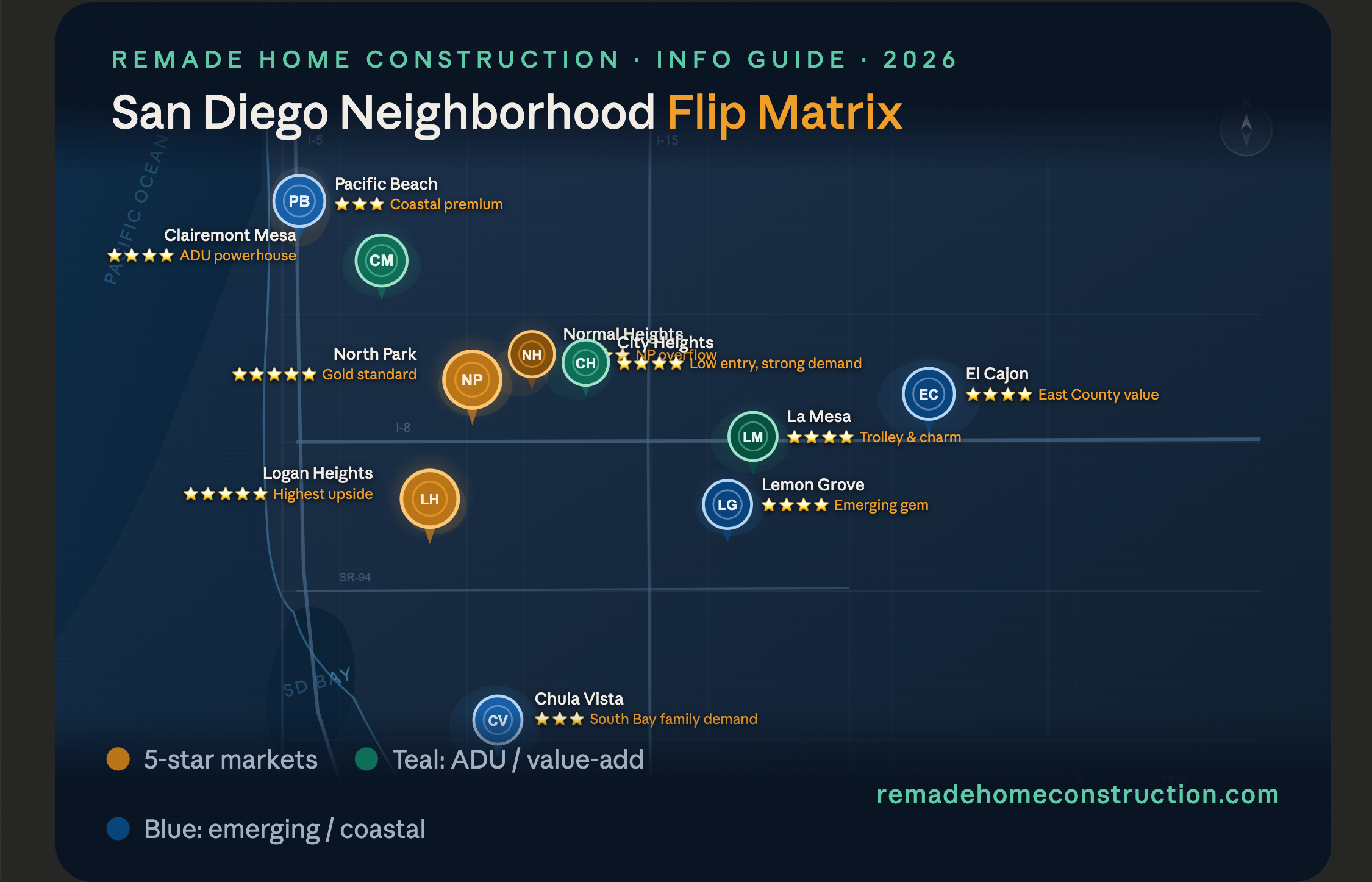
The San Diego Neighborhood Flip Matrix: 2026 Edition
The table below is our working flip matrix for 2026, covering 10 of the most active neighborhoods for fix-and-flip investors in San Diego County. Entry prices, ARVs, and rehab scope are based on current market data and our own project experience.
| Neighborhood | Entry Price Range | Typical ARV | Rehab Scope | Investor Grade | Key Driver |
| North Park / South Park | $750K–$950K | $950K–$1.15M | Cosmetic–Medium | ⭐⭐⭐⭐⭐ | High demand, lifestyle buyers |
| Logan Heights | $550K–$750K | $800K–$950K | Medium–Full | ⭐⭐⭐⭐⭐ | Downtown proximity, gentrification |
| City Heights | $500K–$700K | $700K–$875K | Medium–Full | ⭐⭐⭐⭐ | Low entry, strong rental demand |
| El Cajon | $600K–$750K | $775K–$950K | Medium | ⭐⭐⭐⭐ | Value, improving amenities |
| Lemon Grove | $580K–$720K | $740K–$900K | Cosmetic–Medium | ⭐⭐⭐⭐ | Trolley access, revitalization |
| Clairemont Mesa | $750K–$950K | $950K–$1.15M | Cosmetic–Medium | ⭐⭐⭐⭐ | Mid-century SFR, ADU potential |
| La Mesa | $650K–$850K | $850K–$1.1M | Cosmetic–Medium | ⭐⭐⭐⭐ | Historic charm, trolley access |
| Chula Vista (East) | $700K–$900K | $875K–$1.1M | Light–Medium | ⭐⭐⭐ | Family demand, bayfront investment |
| Normal Heights | $700K–$900K | $900K–$1.1M | Cosmetic–Medium | ⭐⭐⭐⭐ | Spills from North Park |
| Pacific Beach | $900K–$1.3M | $1.3M–$1.7M | Full/Premium | ⭐⭐⭐ | Coastal premium, luxury buyers |
Let’s break down each market in detail.
Neighborhood Deep Dives
1. North Park / South Park — The Gold Standard
North Park has spent the past decade transforming from a mid-century sleeper into one of San Diego’s most desirable urban neighborhoods, and the numbers reflect it. In January 2026, North Park home prices hit a median of $1.0M — up 12.2% year-over-year — with homes selling in roughly 33 days. South Park, its quieter neighbor to the south, tracks closely behind.
What makes North Park exceptional for flippers isn’t just the appreciation — it’s the buyer profile. North Park attracts design-conscious millennials and young professionals who will pay a meaningful premium for a thoughtfully renovated craftsman bungalow or Spanish-style home. This is a market where finishes matter, outdoor spaces are valued, and Instagram-worthy kitchens translate directly to dollars over asking price.
Flip Strategy: Cosmetic-to-medium renovations on 1920s–1950s SFRs. Prioritize kitchen, bathrooms, and indoor/outdoor flow. Don’t over-improve with ultra-luxury finishes — the ARV ceiling doesn’t support it. Target distressed or dated properties in the $750K–$900K range, aim for an ARV of $1.0M–$1.15M.
Watch out for: Historic preservation requirements on some craftsman homes. Always confirm permitting scope (if applicable) before acquisition.
2. Logan Heights — The Highest Upside Play in 2026
Logan Heights may be the single most compelling flip opportunity in San Diego County right now. Located southeast of downtown, the neighborhood has experienced significant gentrification driven by infrastructure investment, cultural preservation, and proximity to the waterfront. Between 2016 and 2024, home values surged dramatically, making it one of the fastest-appreciating submarkets in the city.
The flipper’s edge here is a still-wide spread between acquisition cost and ARV. Entry prices for distressed properties in the $550K–$700K range are common, and renovated comps in the $800K–$950K range are increasingly well-supported. For investors willing to take on medium-to-heavy rehabs on older homes, the margin potential is exceptional by San Diego standards.
Flip Strategy: Medium-to-full renovations on pre-1960s SFRs. Emphasize curb appeal, functional kitchen and bath updates, and clean modern finishes that appeal to value-conscious urban buyers. ADU additions can significantly boost ARV.
Watch out for: Older homes may carry deferred maintenance surprises — foundation, electrical, plumbing. Budget a generous contingency.
3. City Heights — High Cash Flow, Strong Rental Demand
City Heights offers one of the lowest entry points of any centrally located San Diego neighborhood, with distressed properties routinely available below $700K. The neighborhood draws a working-class buyer and renter pool that values clean, functional, well-maintained homes over luxury finishes.
Investor interest in City Heights has grown steadily through 2025 and into 2026, driven by its strong cash flow potential and value-add opportunities. Multiple hard money lenders have expanded their programs to include City Heights, a reliable signal that the institutional investor community has validated the thesis.
Flip Strategy: Medium renovations focused on function and curb appeal. Don’t over-finish — the buyer pool doesn’t support it and you’ll compress your margins. Focus on properties with large lots that have ADU potential, as this can meaningfully increase ARV.
4. El Cajon — The East County Value Play
El Cajon is at an interesting inflection point. With median prices in the $600K–$750K range, it offers meaningful spread to an ARV of $775K–$950K for well-renovated properties. More importantly, El Cajon is showing early signs of the cultural momentum shift that transformed North Park a decade ago — new dining concepts, improved infrastructure, and buyers priced out of La Mesa and Lemon Grove are discovering El Cajon’s relative affordability.
Investors who are early to El Cajon in 2026 are well-positioned to capture appreciation upside over a 12–24 month hold period. The sub-areas of Fletcher Hills and Rancho San Diego are particularly compelling for investors targeting better schools and newer retail access.
Flip Strategy: Medium renovations on 1960s–1980s SFRs. Kitchen and bath updates, fresh exterior, and landscaping go a long way with value-focused buyers in this market.
5. Lemon Grove — The Overlooked Gem Getting Discovered
Lemon Grove sits between La Mesa and Spring Valley, approximately 10 miles from downtown San Diego. For years it has been undervalued relative to its neighbors — but that is changing rapidly. The city is investing $45 million in Main Street revitalization, park improvements, and pedestrian infrastructure. New coffee shops, breweries, and local restaurants are opening. Trolley Orange Line access makes it a legitimate commuter-friendly option for downtown workers.
The result: median prices rose 8% in a single month in early 2025, and demand has continued building into 2026. Lemon Grove currently offers one of the best risk-adjusted entry points in San Diego County for cosmetic-to-medium flip strategies.
Flip Strategy: Cosmetic-to-medium scope on SFRs in the $580K–$720K range. Clean, modern finishes that appeal to first-time buyers and value-seekers moving inland from La Mesa.
6. Clairemont Mesa — The Mid-Century ADU Machine
Clairemont Mesa is centrally located and strategically positioned near University City, Kearny Mesa, and Mission Valley — three of San Diego’s largest employment hubs. The housing stock is predominantly mid-century single-family homes on large lots, which makes Clairemont Mesa one of the most ADU-friendly neighborhoods in the county.
For flippers, the ADU angle is a significant value driver. A well-executed primary home renovation plus an ADU addition can add $200K–$350K to ARV in Clairemont Mesa, making the total project economics compelling even against higher entry costs. The neighborhood’s stability and tenant quality also make it attractive for buy-and-hold investors who want the option to rent post-renovation.
Flip Strategy: Cosmetic-to-medium renovation on primary home + ADU addition where lot size permits. Budget 6–9 months for ADU permitting and construction. The premium on ADU-equipped properties in Clairemont is well-established and buyer-tested.
7. La Mesa — Historic Charm, Trolley Access, Rising Comps
La Mesa’s historic downtown, walkability, and trolley access have attracted a loyal buyer base that continues to drive price appreciation. Median prices have climbed into the $650K–$850K range for SFRs, with renovated properties in desirable pockets pushing well past $900K.
La Mesa buyers tend to be upgrade buyers — people trading up from a condo or entry-level home who want character, walkability, and outdoor space. This buyer profile rewards quality renovations and will pay a meaningful premium for indoor/outdoor flow, updated kitchens, and move-in-ready condition.
Flip Strategy: Cosmetic-to-medium renovations emphasizing the character of older craftsman and Spanish-style homes. Don’t over-modernize — La Mesa buyers appreciate period-appropriate updates that preserve architectural charm.
8. Chula Vista (East / Eastlake) — South Bay Family Demand
Chula Vista is San Diego’s largest suburb and one of the most family-oriented communities in the county. The Eastlake master-planned community and surrounding East Chula Vista neighborhoods offer newer housing stock, excellent schools, and strong family buyer demand that keeps inventory moving.
The Chula Vista Bayfront is also undergoing a $1.2 billion redevelopment — including a Gaylord Pacific Resort and convention center, harbor promenade, and thousands of new residential units — that is expected to create significant demand spillover into adjacent residential neighborhoods when the resort hotels open in 2027–2028.
Flip Strategy: Light-to-medium scope on master-planned SFRs and townhomes. Family buyers in this market prioritize functional layouts, updated kitchens, and curb appeal over high-end finishes.
9. Normal Heights — North Park’s Overflow Market
Normal Heights borders North Park to the east and has benefited substantially from spillover demand as North Park prices have escalated past $1M. Buyers who want the North Park lifestyle at a slight discount discover Normal Heights — and a growing number are landing there intentionally. The neighborhood’s mid-century bungalows and craftsman homes appeal to the same buyer profile that drives North Park, with similar renovation expectations.
Flip Strategy: Similar to North Park: cosmetic-to-medium renovations with attention to architectural character. Entry prices are 5–10% below North Park, providing slightly more margin flexibility.
10. Pacific Beach — High Risk, High Reward Coastal Play
Pacific Beach operates in a different category from the neighborhoods above. Entry prices of $900K–$1.3M mean you need substantial capital and a compelling property to make the numbers work. The coastal premium is real — well-renovated PB properties regularly trade at $1.3M–$1.7M — but the margin is thinner relative to acquisition cost, and carrying costs on a $1M+ acquisition can destroy returns if you hit permit delays or unexpected renovation scope.
For experienced flippers with the capital and contractor relationships to execute quickly, PB can be very rewarding. For less-experienced investors, the risk-adjusted return is better in the previously mentioned neighborhoods above.
Flip Strategy: Full renovations with premium finishes — coastal buyers expect it. Indoor/outdoor flow, durable coastal materials, and outdoor entertaining spaces are non-negotiable. Work with a contractor experienced in coastal renovation compliance.
Applying the 70% Rule in San Diego: What Actually Works
The traditional 70% rule states that you should pay no more than 70% of the ARV minus estimated repair costs. In most U.S. markets, this is a workable starting point. In San Diego’s high-value markets, the math requires some adjustment.
Here’s a realistic deal model for a medium-scope flip in Logan Heights in 2026:
| Item | Amount |
| Target ARV | $875,000 |
| Purchase Price (target) | $620,000 |
| Rehab Budget (medium scope) | $95,000 |
| Carrying Costs (6 months) | $28,000 |
| Closing / Sales Costs (~6%) | $52,500 |
| Total All-In Cost | $795,500 |
| Projected Gross Profit | $79,500 |
| Gross ROI on Investment | ~10% |
Note: This model assumes a 6-month hold period, hard money financing at 10–12%, and a clean title. Actual results vary significantly based on acquisition price, rehab execution, and sell-side market timing. This is illustrative, not a guarantee.
The key takeaway: in San Diego’s high-cost environment, a 10% gross ROI on a well-executed deal is a solid outcome. Flippers who demand 25%+ margins will consistently lose deals to better-capitalized investors in competitive neighborhoods. The winning strategy is to buy well, execute fast, and sell into a ready buyer pool.
The Contractor Factor: Why Your GC Is as Important as Your Zip Code
Here’s something most real estate investing courses don’t cover adequately: in a market like San Diego, your general contractor relationship directly determines whether a deal makes money or loses it.
Consider the variables a reliable GC controls:
- Rehab cost accuracy — an experienced San Diego contractor can give you a credible scope estimate before you make an offer, not after you’re under contract
- Timeline reliability — every week of holding a $700K+ acquisition costs real money in interest, taxes, and insurance; delays compound quickly
- Permit strategy — knowing which improvements can be pulled over-the-counter vs. which require a full plan check can save 2–3 months on a project timeline
- Quality control — a botched renovation in a competitive market means price reductions, longer DOM, and eroded profit
- Relationships — established GCs have relationships with sub-contractors, inspectors, and city permit offices that open doors for investors
At Remade Home Construction, we’ve built our business specifically around the needs of San Diego investors and flippers. We offer transparent, line-item scoping before you commit to a deal, and we execute with the precision that protects your timeline and your margins.
Interested in getting a pre-offer scope estimate for a potential flip? Contact Remade Home Construction — we work with investors throughout San Diego County.
2026 San Diego Market Context: What Investors Need to Know
Before placing any bet in the San Diego flip market, understand the macro context for 2026:
- Countywide median prices closed 2025 at $1,000,000 for single-family homes, up 2.6% year-over-year — steady growth, not bubble territory
- Median days on market is approximately 27–33 days, slightly longer than the 2022 peak frenzy but still fast by historical standards
- Mortgage rates averaging 6.1–6.4% in 2026 — below the 2023 peak, which has restored some buyer confidence and purchasing power
- Inventory increased roughly 47% year-over-year in 2025 — creating more acquisition opportunities for patient investors
- California gross flip ROI declined to approximately 17.7% from 20.8% a year earlier statewide — underscoring the importance of neighborhood selection and cost control
- ADU additions continue to be a significant value driver in San Diego, with permitting smoother than in prior years and buyer demand for ADU-equipped properties strong
The overall picture: San Diego in 2026 is a normalized, competitive market that rewards precision. The easy money is gone, but the well-executed deal is still very much alive — especially in the neighborhoods where Remade Home Construction operates every day.
Key Takeaways: Flip Matrix Summary
- North Park, South Park, and Normal Heights offer the best combination of proven demand, design-conscious buyers, and cosmetic-to-medium rehab profiles
- Logan Heights offers the highest upside margin potential in 2026 for investors willing to take on medium-to-full rehabs
- Lemon Grove and El Cajon are the emerging value plays — early movers stand to capture meaningful appreciation upside
- Clairemont Mesa is the go-to neighborhood for ADU-driven value-add strategies
- Pacific Beach delivers the largest absolute dollar profits but requires the most capital, expertise, and execution speed
- In every neighborhood, a reliable contractor relationship is the single most controllable variable in your project economics
Ready to Execute Your Next San Diego Flip?
Remade Home Construction is a US Navy Veteran-owned construction company specializing in investment flips, full renovations, ADUs, and ground-up builds throughout San Diego County. We’ve completed 100+ projects and bring the precision, transparency, and local market knowledge that serious investors need to protect their margins.
Whether you’re evaluating a deal in Logan Heights, planning an ADU in Clairemont, or executing a premium flip in Pacific Beach, we’re the construction partner that helps you get in, get done, and get out profitably.
Contact Remade Home Construction today: www.remadehomeconstruction.com
Areas we serve: San Diego, La Jolla, Carmel Valley, University City, El Cajon, North Park, South Park, University Heights, Ocean Beach, Point Loma, La Mesa, Lemon Grove, Del Mar, Rancho Santa Fe, Solana Beach, Encinitas, Chula Vista, Bay Park, Pacific Beach, and surrounding communities.
Related Articles from Remade Home Construction: