
HELOCs, Construction Loans, and ADU-Specific Financing Explained
San Diego homeowners have more reasons than ever to build an ADU. Rental income, multigenerational living, increased property value — the upside is real and well-documented. But for most people, the conversation hits a wall at the same place: How do I actually pay for this?
It’s a fair question – A detached ADU in San Diego can cost anywhere from $200,000 to $450,000 when all is said and done — design, permits, sitework, and construction included. That’s not a home improvement. That’s a significant capital project, and it deserves a serious financing strategy.
The good news is that San Diego homeowners in 2026 have more ADU financing options than ever before — from city-backed construction loans with below-market interest rates to HELOCs, cash-out refinances, and renovation loans that factor in your ADU’s future rental income. The bad news is that not every option fits every situation, and the wrong financing choice can erode the very returns you’re building toward.
This guide breaks down the most common ADU financing paths available to San Diego homeowners today — what they are, who they’re best for, what the trade-offs look like, and how to think about layering multiple sources for the most cost-effective outcome.
Pro Tip: Check out our article: Complete Guide to Building an ADU in San Diego: Types, Costs, and Construction Process to learn how to plan for, design, and build an ADU.
First: Know Your Total Cost Before You Choose a Financing Path
Before comparing financing options, you need an honest budget — not a ballpark, but a real number that accounts for every line item. Many homeowners get into trouble because they plan for construction costs alone and get blindsided by soft costs.
Here’s how ADU costs typically break down in San Diego in 2026:
| Cost Category | What It Includes | Typical Range (San Diego) |
|---|---|---|
| Hard Costs (Construction) | Foundation, framing, labor, materials, finishes | $300K–$450K+ (detached); $100K–$200K (garage conversion) |
| Soft Costs (Pre-Construction) | Architectural plans, engineering, soil tests, energy reports | $15,000–$40,000 |
| Permit Fees | City plan check, building permits, school fees (if >500 sq ft) | $6,500–$21,000 depending on size and city |
| Site Work | Grading, utility connections, access improvements | $10,000–$50,000+ depending on lot conditions |
| Contingency (Recommended) | Buffer for unexpected conditions, design changes | 10–15% of total project budget |
The bottom line: A realistic all-in budget for a detached ADU in San Diego typically falls between $250,000 and $450,000+. Garage conversions are more accessible, usually landing in the $100,000–$200,000 range. Know your number before you approach any lender.
| Pro Tip from Remade Home Construction:Before you choose a financing path, get a detailed written estimate from your contractor — not a verbal range. Lenders will want documentation, and a vague estimate is one of the most common reasons ADU loan applications stall or fall apart mid-process. |
Option 1: The SDHC ADU Finance Program — San Diego’s Best-Kept Financing Secret
If you’re a moderate-income homeowner in the City of San Diego and you haven’t looked into the San Diego Housing Commission’s ADU Finance Program, start here. It offers some of the most competitive loan terms available anywhere in California for ADU construction.
How it works
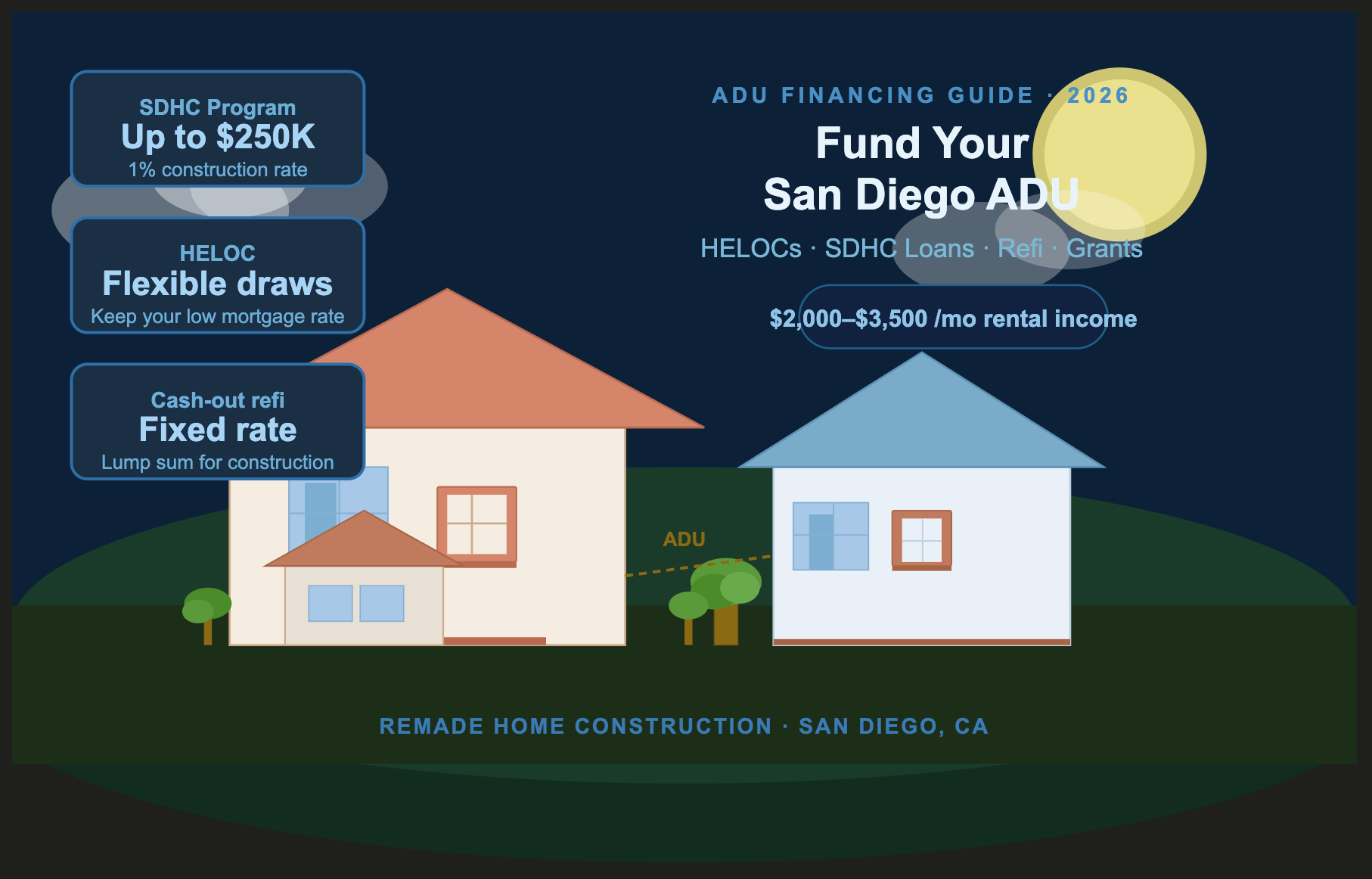
The SDHC ADU Finance Program offers construction-to-permanent loans of up to $250,000, with a 1% interest rate during the construction phase, converting to a 4% fixed rate for a 15-year permanent loan after completion. The program also includes free technical assistance — meaning access to pre-reviewed architectural plans, permit navigation support, and project guidance at no cost to the homeowner.
That technical assistance alone can be worth $10,000–$25,000 in savings on design and permitting soft costs.
Who qualifies
- Must be owner-occupant in the City of San Diego (zip codes beginning with 921XX)
- Annual household income up to $231,000 (150% of San Diego’s Area Median Income)
- Minimum credit score of 680
- Property must be a detached single-family residence
- Owner contribution of 1% of the construction loan amount required
The trade-off: the affordability covenant
In exchange for the favorable financing, the ADU’s rent must remain affordable for seven years — restricted to households earning 80% or less of San Diego’s Area Median Income (AMI). You also cannot rent to a family member during this period.
For homeowners whose primary goal is long-term wealth-building rather than immediate maximum rental income, this is often a reasonable trade. After the seven-year restriction period, you can rent at full market rate.
| Is this right for you?The SDHC program is ideal if you qualify on income, you’re planning a long-term rental (not a short flip), and you want to minimize borrowing costs. The 1% construction rate is genuinely exceptional — it dramatically reduces interest costs while your ADU is being built. Contact SDHC directly at adu@sdhc.org to check current availability and apply. |
Option 2: HELOC (Home Equity Line of Credit) — The Flexible Choice for Equity-Rich Homeowners
For homeowners who have built up significant equity — and San Diego’s strong property values mean many have — a HELOC is often the simplest, most flexible path to ADU financing.
How it works
A HELOC is a revolving line of credit secured against your home’s equity. You draw funds as needed during construction (paying interest only on what you’ve used), then repay the balance over time. Critically, a HELOC doesn’t replace your existing mortgage — so if you locked in a low rate in 2020 or 2021, you keep it.
Most lenders cap combined loan-to-value (CLTV) at 80–90%, meaning the total of your mortgage plus the HELOC can’t exceed 80–90% of your home’s current value. With San Diego’s median home value hovering around $925,000, many homeowners have substantial borrowing room.
Best for
- Homeowners with significant equity and a low-rate existing mortgage they want to preserve
- Projects where construction will happen in phases (draw flexibility is a major advantage)
- Borrowers who want minimal closing costs and fast approval timelines
Watch-outs
- HELOCs typically carry variable interest rates — if rates rise during your build, your borrowing costs increase
- Your equity must be sufficient to cover the project; many ADU builds exceed what a HELOC alone can fund
- Some lenders have tightened HELOC availability — shop local credit unions like San Diego County Credit Union and Mission Federal, which often offer more competitive terms than large national banks
Option 3: Cash-Out Refinance — Access Equity at a Fixed Rate
A cash-out refinance replaces your existing mortgage with a new, larger loan — and you receive the difference in cash to fund your ADU. Unlike a HELOC, the rate is fixed, giving you predictable payments for the life of the loan.
How it works
Say your home is worth $800,000 and you owe $400,000. A cash-out refi at 80% LTV gives you a new loan of $640,000 — netting $240,000 in cash after paying off the original mortgage. You then use those funds for ADU construction.
In 2026, the Federal Housing Finance Agency set conforming loan limits for San Diego County at $1,104,000 for single-unit properties, creating meaningful refinance opportunities for homeowners who can stay within that ceiling and avoid jumbo loan requirements.
Best for
- Homeowners whose current mortgage rate is close to today’s market rates (so they’re not sacrificing a great rate to refi)
- Projects requiring a larger lump sum upfront — particularly useful for detached ADU builds with high site prep costs
- Borrowers who prefer a single fixed-rate monthly payment over a variable line of credit
Watch-outs
- If your existing mortgage rate is significantly lower than today’s rates, a cash-out refi will raise your monthly payment substantially — run the numbers carefully
- Closing costs on a refinance typically run $3,000–$6,000+, which eats into your net proceeds
- Processing takes 30–45 days, which can delay project start
| Rate Sensitivity CheckIf your existing mortgage is at 3–4% and today’s 30-year rates are 6.5–7.5%, a cash-out refi could dramatically increase your monthly payment. In that scenario, a HELOC or renovation loan that preserves your first mortgage is almost always the smarter play. |
Option 4: Construction and Renovation Loans — When Equity Alone Won’t Cover It
If your home equity isn’t enough to cover your full ADU budget, construction and renovation loans offer a path forward — because they’re underwritten based on your property’s after-improvement value (the projected worth once the ADU is complete), not its current value.
Construction loans
Traditional construction loans fund in draws tied to project milestones, with interest-only payments during the build. Once construction is complete, the loan typically converts to a permanent mortgage. These loans require more documentation (contractor bids, plans, permits) and can have higher origination costs, but they allow you to borrow more than your current equity would allow.
Renovation loans (FHA 203k and Fannie Mae HomeStyle)
These government-backed products combine your purchase or refinance mortgage with construction financing into a single loan. The HomeStyle Renovation loan in particular is popular for ADU builds because it allows borrowing up to 75% of the completed appraised value — meaning the lender is betting on what the property will be worth when the ADU is done, not what it’s worth today.
Best for
- Homeowners with limited current equity but strong income and good credit
- First-time ADU builders who want a single loan that handles both mortgage and construction
- Projects where the ADU will meaningfully increase property value (most San Diego ADU builds do)
What About the CalHFA ADU Grant?
Many San Diego homeowners have heard about California’s ADU Grant Program — up to $40,000 in grant funding (not a loan — no repayment required) for pre-development and soft costs like plans, permits, engineering, and soil tests.
As of early 2026, the CalHFA ADU Grant Program is paused, with all current funding fully allocated. The program launched with approximately $100 million and was distributed on a first-come, first-served basis until exhausted.
That said, California has appropriated additional ADU Grant funding in previous years when demand justified it. Homeowners should monitor the CalHFA website (calhfa.ca.gov) for any new funding rounds — if the program reopens, the $40,000 in soft-cost coverage could significantly reduce your overall borrowing needs.
| Important Scam WarningCalHFA has specifically warned homeowners: if anyone contacts you claiming they can help you access the CalHFA ADU Grant, it is a financial scam. The program only operates through official channels. Do not pay anyone to “help” you apply. |
Side-by-Side Comparison: Which Option Fits Your Situation?
| Financing Option | Loan Amount | Interest Rate | Best For | Key Trade-off |
|---|---|---|---|---|
| SDHC ADU Program | Up to $250,000 | 1% construction / 4% permanent | Moderate-income City of SD owner-occupants | 7-year affordability covenant on rent |
| HELOC | Depends on equity (80-90% CLTV) | Variable (currently competitive) | Equity-rich homeowners preserving low first mortgage | Variable rate risk; equity-dependent |
| Cash-Out Refinance | Up to 80% LTV of home value | Current fixed market rate (6.5–7.5%) | Homeowners near current market rates | Replaces your existing mortgage rate |
| Construction Loan | Based on project scope | Typically higher than standard mortgages | Low-equity homeowners with strong income | More documentation; higher origination costs |
| Renovation Loan (HomeStyle/203k) | Up to 75% of completed value | Competitive fixed rates | Buyers or refi borrowers with limited equity | Single loan structure; appraiser-dependent |
| CalHFA ADU Grant | Up to $40,000 (grant, not loan) | N/A — no repayment | Income-eligible homeowners (when available) | Currently paused; monitor for new rounds |
The Smartest Strategy: Layer Your Financing Sources
Experienced ADU builders rarely rely on a single financing source. The most cost-effective approach layers multiple options:
- Step 1: Start with any available grants or low-cost programs (SDHC or CalHFA if available) to cover soft costs and reduce your total loan amount.
- Step 2: Add a HELOC to fund construction draws flexibly, preserving your existing first mortgage if the rate is favorable.
- Step 3: After the ADU is complete and has been appraised at its new value, consider refinancing into a permanent fixed-rate mortgage that consolidates your debt at a lower long-term rate.
This layered approach minimizes construction-phase interest costs, preserves optionality, and positions you for the most favorable long-term financing once the ADU is generating rental income.
The ROI Reality Check: Do the Numbers Work?
It’s worth running a basic projection before you commit to any financing path. Here’s an illustrative example based on San Diego market data in 2026:
| Scenario | Details |
|---|---|
| ADU Type | Detached, 1-bedroom, 650 sq ft |
| Total Build Cost | $280,000 (all-in) |
| Financing | $250,000 HELOC at 7.5% variable / $30,000 cash |
| Monthly Payment (Interest Only During Build) | ~$1,560 |
| Monthly Rental Income (Central San Diego) | $2,000–$2,500/month |
| Net Cash Flow After Financing Payment | $440–$940/month positive |
| Estimated Property Value Increase | 20–30% of ADU cost ($56,000–$84,000) |
| Full ROI (Construction Cost Recovery via Rent) | ~7–10 years |
In coastal neighborhoods like La Jolla, Del Mar, or Ocean Beach, rental income for a well-built ADU can reach $3,000–$3,500/month — compressing the payback period significantly. In inland neighborhoods, expect the lower end of the range.
| Important Note on Prop 13 – Building an ADU in California triggers only a partial property tax reassessment — specifically for the value of the new construction added to your lot. Your primary residence’s existing assessed value and its Proposition 13 protections remain intact. This is a meaningful tax advantage that often surprises homeowners planning their first ADU. |
Ready to Build? Start with the Right Contractor — and the Right Financing.
Financing an ADU isn’t just about finding money. It’s about structuring capital in a way that makes the project financially sound from the day you break ground through the day you hand over the keys to your first tenant.
At Remade Home Construction, we’ve worked with San Diego homeowners on every type of ADU project — detached backyard builds, garage conversions, attached additions, and ground-up designs — across neighborhoods from North Park and Ocean Beach to Carmel Valley and La Mesa. We understand how project scope, site conditions, and construction timelines interact with your financing options, and we can help you build a realistic budget from the start.
The best ADU financing plan starts with a clear construction estimate. If you know what you’re building and what it actually costs, the right financing path becomes much easier to identify.
Talk to Remade Home Construction before you talk to a lender. A solid contractor estimate is the foundation of a solid financing plan — and we’re here to help you build both.
***Contact Remade Home Construction***
www.remadehomeconstruction.com | San Diego, CA | Veteran-Owned & Operated
DISCLAIMER
This article is intended for informational purposes only and does not constitute financial or legal advice. Financing programs, interest rates, income limits, and program availability are subject to change. Readers should verify current program details directly with the San Diego Housing Commission (sdhc.org), CalHFA (calhfa.ca.gov), and their preferred lenders before making any financial decisions. Remade Home Construction is a licensed general contractor and is not a mortgage lender, financial advisor, or legal professional
Leave a Reply