
Investor Playbook · San Diego House Flipping Renovation Guide
From Distressed to Desirable:
A Room-by-Room Rehab Playbook
for San Diego Single-Family Flips
A tactical walkthrough of a typical San Diego house flipping — what to tackle in each room, standard vs. premium finishes by price point, and the sequencing that keeps your project on schedule and on budget.
San Diego’s flip market in 2026 rewards investors who have a plan — and punishes those who wing it. With median SFR prices hovering around $970K–$1.05M, labor costs running 23% above national averages, and permit timelines stretching 4–6 months, the difference between a $120K profit and a $30K loss often comes down to one thing: execution clarity before you ever swing a hammer.
At Remade Home Construction, we’ve rehabbed dozens of single-family homes across San Diego — from Carmel Mountain to Rolando Village to the UTC corridor. This playbook distills exactly what we do, room by room, project phase by project phase, to turn distressed properties into homes that sell fast and for top dollar.
Tactic One: Sequencing
The Sequencing That Keeps You on Schedule
The single biggest reason flips blow their budgets isn’t material costs — it’s sequencing errors. Errors like starting drywall before rough plumbing is inspected. Or installing cabinets before flooring is acclimated. Jumping on painting before the HVAC crew has punched through ceilings.
Here’s the correct order of operations for a typical San Diego SFR flip:
Weeks 1 – 2
Demo, Hazmat & Structural Assessment
Full demo — interior finishes, flooring, kitchen cabinets, bath fixtures. Asbestos and lead testing (mandatory for SD homes built before 1980). Foundation inspection for clay soil movement, raised foundation checks, and any seismic concerns. This phase reveals all the hidden surprises before you’re committed to a scope. Budget a 15–20% contingency here.
Weeks 2 – 4
Framing Changes, Rough Mechanical, Electrical & Plumbing (MEP)
Framing any layout modifications (kitchen wall removal, bathroom additions). Panel upgrades, re-wire for modern loads, re-pipe galvanized or cast-iron drain lines, HVAC rough-in. In San Diego, expect to upgrade to 200-amp service on virtually any 1950s–1970s home. All MEP work must be inspected and signed off before walls close. If permitting your project – submitting your permits during escrow (a Remade specialty) will help get a jump-start on the process and permitting timeline.
Weeks 4–5
Insulation & Drywall
Open-wall insulation upgrades, drywall hang and texture. In San Diego coastal areas, vapor barriers matter. If you’re adding sq ft or converting a garage, this is where permits are absolutely essential, and the work is inspected.
Weeks 5 – 7
Kitchen & Bath Installation
Cabinets first, then countertops, then appliances and plumbing trim-out. Shower and tub tile, vanities, mirrors, fixtures. This is your highest ROI work — treat it accordingly. Sequence tile before vanity tops; set toilets last.
Weeks 7 – 9
Flooring, Paint & Interior Trim
Interior paint, then Hardwood/LVP installation, then base and door trim. Critical rule: never put flooring in before painting — overspray on fresh LVP is a common rookie mistake. Exterior paint and any stucco/exterior cladding repairs run concurrently.
Weeks 9 – 11
Punch List, Landscaping & Staging Prep
Finish electrical trim (outlets, switches, fixtures), HVAC registers, hardware throughout. Exterior: fresh landscaping, sod or drought-tolerant ground cover, concrete driveway sealing or replacement, front door and garage door. In San Diego, curb appeal drives 10–15% of buyer emotional connection before they walk through the door.
San Diego-Specific Sequencing Note
- Pre-file permits during escrow whenever possible (if permitting your project) — SD’s permit backlog averages 2–4 weeks for over-the-counter pulls and 4–6 months for full permits/structural work
- Schedule inspections immediately after rough MEP — don’t let inspections become your critical path blocker
- Clay soil issues in inland neighborhoods (Carmel Mountain, Santee, El Cajon) may require a soils engineer sign-off, adding 1–2 weeks
- Termite clearance from a licensed pest operator is required before close — get this done in Week 1, not Week 10
Tactic Two: Planning
Room-by-Room: What to Tackle & How to Finish It
For each room below, we break down what to always address, what to do by price point, and the finish choices that move the needle on ARV in the San Diego market.
The Kitchen
Highest ROI room in the house — 80–90% cost recoup in San Diego per 2026 data
The kitchen makes or breaks a San Diego flip. Buyers in this market — even at entry-level price points — have seen enough HGTV to know when a kitchen is tired. Your job isn’t to build the kitchen of their dreams; it’s to build the kitchen that photographs well, feels generous, and has no obvious weaknesses that a buyer’s agent can use to negotiate you down.
| Finish Tier | ARV Target | Cabinet Choice | Countertop | Appliances | Budget Range |
|---|---|---|---|---|---|
| Standard | $700K–$850K | Stock RTA in shaker style (white or gray) | Quartz (Silestone or MSI basics) | Stainless Samsung or LG suite | $28K–$42K |
| Mid-Range | $850K–$1.1M | Semi-custom in white or two-tone; soft-close hardware | Quartz with waterfall island or subway backsplash | KitchenAid or Bosch suite | $45K–$68K |
| Premium | $1.1M+ | Custom or semi-custom with integrated panels | Calacatta quartz, leathered quartzite, or Dekton | Thermador or Wolf/Sub-Zero | $72K–$110K+ |
Always do regardless of price point: Replace range hood and vent to exterior, upgrade to recessed LED lighting on dimmers, add a kitchen island or peninsula if the layout allows (San Diego buyers want kitchen gathering space), install a garbage disposal, and update to a single-basin undermount stainless sink.
Open the floor plan if structurally feasible. Removing the wall between kitchen and living room is one of the single highest-ROI moves in a San Diego flip. Our Carmel Mountain project opened a closed-off kitchen to create cathedral-ceiling great room flow — this one change transformed the feel of the entire home and contributed directly to the sale outcome.
Remade Pro Tip:
In the $850K–$1.1M range, buyers increasingly expect a dedicated coffee/beverage station or built-in pantry cabinet. Adding one open-shelf section to an otherwise full upper-cabinet run costs almost nothing but reads as intentional, modern design in listing photos.
Bathrooms
56–73% cost recoup; count and quality both matter for ARV
In San Diego, a 3-bed/1-bath home is a hard sell above $750K. One of the most reliable ARV boosters on older inland properties is converting a secondary bedroom, hallway, or reconfiguring the spaces to create second bathroom (Ideally a ensuite or master bathroom). If the plumbing stack runs nearby, the cost is often $18K–$28K — and it can add $60K–$100K to your sale price. Always run this math with your contractor before you finalize scope.
| Finish Tier | ARV Target | Tile Choice | Vanity | Shower/Tub | Budget Range |
|---|---|---|---|---|---|
| Standard | $700K–$850K | 12×24 porcelain, neutral gray or white | Stock 36″ vanity with cultured marble top | Tile-surround tub/shower combo | $12K–$22K each |
| Mid-Range | $850K–$1.1M | Large format (24×48) with accent niche | Floating double vanity, quartz top | Walk-in frameless glass shower; freestanding tub in primary | $24K–$40K each |
| Premium | $1.1M+ | Marble-look or genuine stone; heated floor | Custom floating millwork, vessel or integrated sink | Curbless shower, body jets, rainfall head; soaking tub | $42K–$70K+ each |
California code requirements to budget for: Water-saving fixtures (1.28 GPF toilets, 1.8 GPM showerheads), GFCI outlets within 6 feet of all water sources, and exhaust fans vented to exterior. These are non-negotiable — inspectors will catch every one.
Remade Pro Tip:
Spend the extra $600 on a frameless lighted mirror in the primary bath. It photographs dramatically better than framed mirrors and is one of the details buyers notice in listing photos — which is where your flip gets sold or skipped.
Buyers in 2026 want a retreat — deliver sanctuary, not just a bedroom!
Primary Suite
The primary suite has become the second-most-scrutinized space in a San Diego flip after the kitchen. Buyers want to feel like they’re walking into something elevated — not just a room with new paint. Closet space, natural light, and a sense of calm are the three things that drive emotional attachment to the primary bedroom.
Standard moves for every flip: New interior doors with privacy hardware, fresh paint in warm neutrals (Sherwin-Williams Accessible Beige or Agreeable Gray remain reliable), ceiling fan with LED, and new LVP flooring. Build out the master closet with a basic system (ClosetMaid or similar) — a bare rod and shelf looks dated in any price tier.
Mid-range and above: Add wainscoting or an accentt wall (board-and-batten or a painted accent wall behind the bed location). Pre-wire for a wall-mounted TV. Consider vaulted ceilings if the roofline allows — our Carmel Mountain flip leveraged existing roof structure to open cathedral ceilings in the great room and primary, a feature that appeared in every showing conversation.
Remade Pro Tip:
In the $1M+ range, add a dedicated reading nook, window seat, or small sitting area if square footage allows. This detail reads luxury without expensive materials — it’s pure spatial design.
Living, Dining & Common Areas
The spaces that set the tone on first impression — photograph them to sell the lifestyle.
San Diego buyers buy a lifestyle, not just square footage. The living and dining area needs to communicate indoor-outdoor California living the moment someone walks in. Maximize natural light, create sight lines to the backyard if possible, and use flooring continuity throughout to make the home feel larger than it is.
Flooring is your biggest single decision in common areas. Wide-plank LVP (7″ or wider) in warm wood tones has replaced 6″ engineered hardwood as the dominant choice in the $750K–$1.1M tier — lower cost, more durable, and nearly indistinguishable in photos. For true premium flips ($1.5M+), real hardwood or high-grade engineered still earns a price premium in certain neighborhoods like La Jolla adjacent, Encinitas, and Carmel Valley.
| Element | Standard | Mid-Range | Premium |
|---|---|---|---|
| Flooring | 6″ LVP, warm gray/beige tone | 7–9″ wide plank LVP, oak-look | Engineered hardwood or solid oak |
| Fireplace | Refinish surround, new insert if gas | New tile surround, floating mantle | Full reframe, stone or shiplap feature wall |
| Lighting | Recessed LED throughout, pendants on peninsula/island | Recessed + statement chandelier or pendants | Layered lighting plan; designer fixtures |
| Doors/Hardware | Solid core interior, satin nickel hardware | Solid core, matte black or brushed gold | Custom or semi-custom doors, matched hardware sets |
Remade Pro Tip:
Consistency in hardware finish throughout the home (matte black, brushed nickel, or brushed gold — pick one and commit) is a design detail that buyers subconsciously register even when they can’t articulate it. Mixing metals signals “flipper” to experienced buyers and agents. (That said, a curated/designer-selected, tasteful mix can pop)
Exterior, Curb Appeal & Outdoor Living
San Diego’s climate is a feature — sell it; indoor-outdoor flow drives 10–15% of emotional value.
Nowhere else in the U.S. does outdoor space contribute more to resale value relative to cost than in San Diego. The climate makes backyards functionally livable 330+ days per year. Buyers know this — and they’re actively trying to picture themselves outside. A barren concrete slab with a dying lawn is leaving serious money on the table.
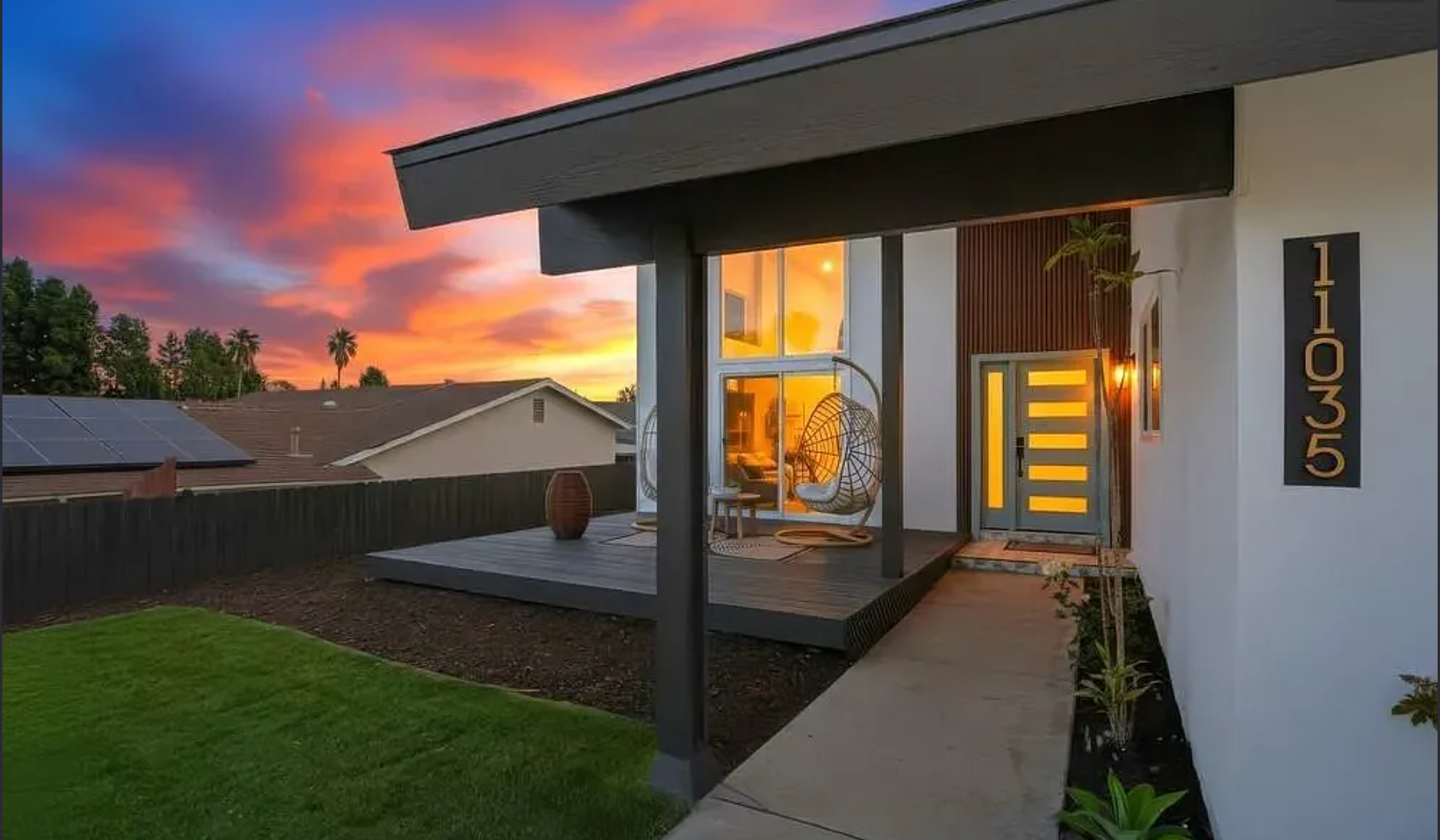
Curb appeal is your first impression, and in 2026, your listing photos are your first showing. Fresh exterior paint (a new color from the stock range), a new front door in a contrasting color (deep navy, forest green, or warm black), updated house numbers and exterior lighting, and clean landscaping are minimum standards for any SD flip.
| Outdoor Element | Standard ($700K–$850K) | Premium ($1M+) | Est. ARV Impact |
|---|---|---|---|
| Landscaping | Sod or drought-tolerant groundcover, clean borders | Full drought-tolerant design with decomposed granite, succulents, specimen trees | $15K–$35K |
| Patio/Deck | Concrete pad pour or resurface | Pavers, pergola, or La Cantina-style folding doors | $20K–$60K |
| Fencing | Wood board-on-board, clean stain | Horizontal cedar with steel post accents | $8K–$18K |
| Garage Door | New 2-panel insulated steel | Contemporary glass-panel or wood-look insulated | $3K–$8K |
Remade Pro Tip:
Drought-tolerant landscaping isn’t just an aesthetic choice — California buyers understand water costs and restrictions. A well-designed drought-tolerant yard signals low maintenance and forward-thinking ownership. It stages better for aerial drone shots too, which are now standard on any SD listing above $800K.
Systems: HVAC, Electrical, Plumbing & Roof
The boring stuff that kills deals — or prevents them from dying in inspection.
Savvy San Diego buyers in 2026 — and their agents — know to hammer on systems. A beautiful kitchen can’t save a deal that falls apart because the inspector found a 40-year-old panel, galvanized supply lines, and a failing composition roof. Address systems proactively or negotiate them into your purchase price. You’ll pay for them either way — better to control the cost than to discount the ARV.
- Electrical: Upgrade to 200-amp service on any pre-1990 home. Replace Federal Pacific or Zinsco panels immediately — they’re insurance liabilities and will kill deals. Add GFCI breakers where required by code (kitchen, bathrooms, garage, exterior). Install EV-ready outlet in garage ($800–$1,200) — it’s a deal sweetener that’s becoming a buyer expectation in SD.
- Plumbing: Re-pipe galvanized supply lines with copper or PEX on any 1950s–1970s home. Replace cast-iron drain lines that show deterioration. Water heater: install a tankless on-demand unit (with a recirculating pump on larger homes) — they read as an upgrade, save utility costs, and California buyers increasingly expect them.
- HVAC: Install a new forced-air system or mini-split in homes that lack central air — this is increasingly essential for resale above $750K. Replace systems older than 15 years. Clean and inspect ducts. In coastal SD, mini-splits are often the better value option in homes without existing duct runs.
- Roof: A roof over 15 years old with deferred maintenance will come up in every inspection. Budget to replace vs. repair unless it’s in genuinely solid condition. New composition shingles: $18K–$30K for a typical SD SFR. Don’t fight this in inspection negotiation — replace it proactively and market it.
- Seismic: Cripple wall bolting and shear wall retrofits are required by certain SD lenders for pre-1940 homes. Strap all post and piers on raised foundations. Complete these during rough phase — don’t leave them for inspection surprises.
Portfolio Case Study
Carmel Mountain Rehab-to-Relist: The Anatomy of a Successful SD Flip
Our most recently completed rehab in Carmel Mountain illustrates the full sequencing and finish strategy in action. The property arrived as a dated, closed-floor-plan home with original kitchen, original bathrooms, and no indoor-outdoor connection to the backyard. Here’s what Remade did and why:
We opened the kitchen wall to create a cathedral-ceiling great room with an accent wall feature — that single change that made every buyer stop talking when they walked in. Kitchen received semi-custom euro-style cabinetry, quartz countertops, and a newappliance suite. Both baths were fully tiled. LVP throughout. Exterior paint refresh, new garage door, and a paver patio in the backyard connected the indoors to the outdoor living space.
The result speaks for itself in the photos — and in the numbers.
Project Timeline: 11 Weeks
Rehab Cost: On Budget
Sold In: Fast
Key Move: Open Floor Plan + Cathedral Ceilings
Decision Framework
How to Choose Your Finish Tier: The ARV-First Approach
The most common mistake San Diego investors make is choosing finishes based on personal taste — or based on what the last contractor recommended. Finish tier should flow directly from your ARV target and your comparable sales. Here’s how Remade approaches the decision with every investor client.
The ARV-First Finish Formula
Step 1: Pull 5–7 comps from Redfin/Zillow/MLS that have sold in the last 90 days within ½ mile. What finish level do the top comps have? That’s your ceiling — matching it is the goal, not exceeding it.
Step 2: Apply the 70% Rule as a sanity check. ARV × 70% − Repair Costs = Maximum Offer. If you’re already in the deal, work backward to confirm your scope is still profitable.
Step 3: Categorize every scope line item as Must-Do (structural, code compliance, safety, systems) vs. Value-Add (kitchen, baths, flooring) vs. Nice-to-Have (feature walls, smart tech, premium appliances). Cut Nice-to-Haves first if your budget tightens.
Step 4: Always keep a 15–20% contingency unallocated. In San Diego, you will find something unexpected — clay soil, asbestos, knob-and-tube wiring, water intrusion. Budget for it before demo, not after.
2026 San Diego Cost Benchmarks (Remade Internal Data)
- Minor cosmetic update (paint, hardware, landscape, fixtures): $25K–$50K
- Mid-range kitchen + 2 bath renovation: $65K–$110K
- Full house rehab, 1,500–2,200 sq ft: $120K–$220K
- Full gut + layout change, 2,000–3,000 sq ft: $200K–$400K
- Typical profitable SD flip total renovation: $75K–$150K
- Labor costs: 23% above national average; budget $75–$150/hr for skilled trades
- Permits: $1,000–$5,000 for standard work no-plan permits; full plans with structural adds $10K–$30K in soft costs
Your Next Flip Starts With a Free Walkthrough

Remade Home Construction partners with San Diego investors from preliminary site walks, to due diligence, and through relist. We offer free property evaluation walkthroughs, 48-hour preliminary bids, and ARV input — before you make your offer.Schedule a Free Property Evaluation. You can also get more free info and education about flipping, real estate investing, and ADU’s by checking out our info guides section.
remadehomeconstruction.com | remadehomeconstruction@gmail.com | US Navy Veteran-Owned | CSLB Licensed | San Diego, CA
© 2026 Remade Home Construction · San Diego, CA · All costs reflect 2026 San Diego market data; individual project costs vary based on scope, location, and site conditions. Always consult a licensed contractor for project-specific estimates.